


Health and Wellbeing
What is a perching stool, and who is it for?
Everyday tasks such as cooking, brushing your teeth, or ironing can become difficult if you struggle to stand for long periods – a perching stool may offer a simple solution.
This practical mobility aid can help bring greater comfort, ease, and independence to daily life.
Read on to discover what a perching stool is, the benefits it can bring, and how to choose the right one for your needs.
Key takeaways:
- Perching stools help you rest while staying upright, ideal for daily tasks that require standing.
- Different types of perching stools offer varying levels of support, comfort, and portability.
- Choosing the right perching stool depends on your mobility needs and lifestyle preferences.


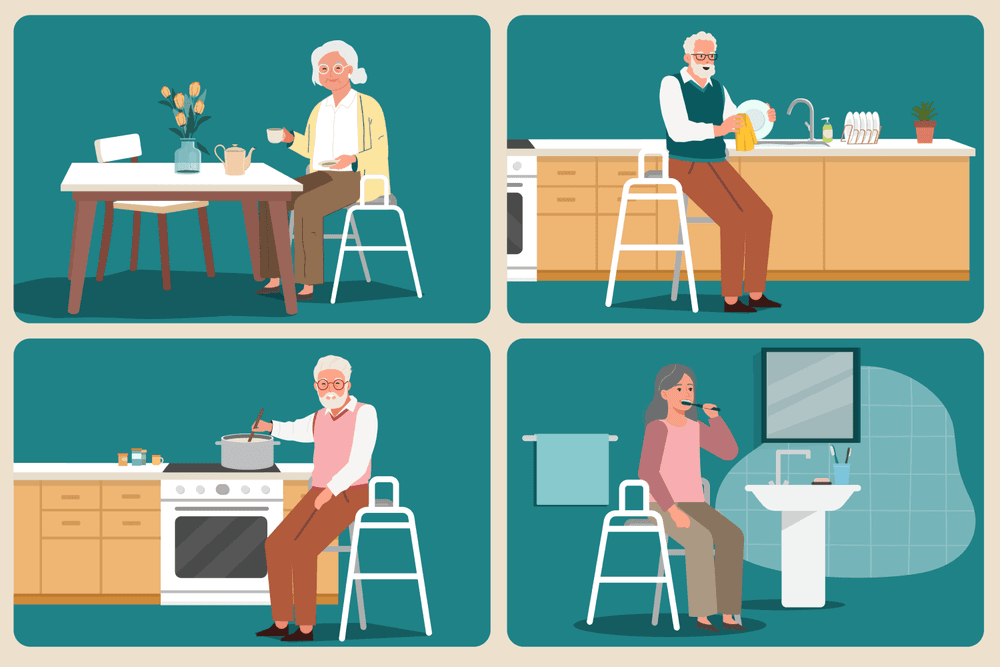
Patricia uses a perching stool to relax while sipping tea at the table.
What is a perching stool?
A perching stool features an angled seat that allows the user to rest or ‘perch’ in a semi-standing position, keeping the hips higher than the knees. Unlike a traditional stool or chair, it has a slightly forward seat and angled legs. This design helps support you while remaining partially upright and active.
Most perching stools are lightweight enough to move around the home. They are also designed to be adjustable to the user’s height.
Who is a perching stool for?
Perching stools can benefit many individuals, including people who experience:
- Difficulty standing for long periods
- Arthritis, joint pain or hip and knee problems
- Discomfort after surgery, such as a hip or knee replacement
- Fatigue conditions, including ME/CFS, MS, and Parkinson's disease
Types of perching stools
| Features | Standard | Folding | With back support | With armrests |
| Portability | Light enough to lift | Moves easily when folded | A little harder to transport | More difficult to carry |
| Support | Limited, but keeps you stable | Varies with back or arm support | Good for back pain | Helps with getting up |
| Comfort | Better for quick tasks | Dependent on additional features | Great for longer use | Gives security when sittin |
| Ease of transport | Medium | Very high | Low | Low |
Standard perching stool
A standard perching stool is ideal for general, short-term use. With no backrest or arms, it’s relatively light and portable. This makes it easier to move around the house.
Perching stool with back support
If you need support standing for longer, a perching stool with back support can be particularly helpful. Having back support can provide extra security when near a counter or tabletop.
Perching stool with arms
Perching stools with armrests can help those who struggle to get up from a seated position. These types of stools usually come with a backrest as well, providing additional support.
Folding perching stool
Foldable stools are helpful for storage and transportation. They often fold flat, making them easy to fit into car boots, tight spaces, or store away when not in use.
What to look for when buying a perching stool
Height adjustability:
Most perching stools can be adjusted to suit the user’s height and the surface in front of them.

David uses a perching stool to make washing up and drying dishes easier.
Portability:
Choose a foldable model to save space, or one with a lightweight frame if travelling. Keep in mind that models with arm or back support could be bulkier and trickier to carry.
Arm support:
For anyone with limited mobility or poor balance, armrests on a perching stool are essential for comfort.
Back support:
Good lumbar support is important if you experience any back pain, as sleep expert Dr Nerina Ramlakhan explains: “For preventing and easing pain you may be experiencing, choose a chair that provides support for the natural curve of your lower spine.”
Where can you use a perching stool?
A perching stool is more versatile than you think and supports a range of tasks across the home:
Kitchen
A perching stool for kitchen use can provide rest when working at surfaces and washing up.
Having a perching stool for cooking is also useful. Food preparation, such as chopping and stirring on the stove, can be less demanding when in a perched position.

Frank uses a perching stool to comfortably stir pots on the stove.
Bathroom
Have you noticed stiffer joints at the beginning and end of the day? A perching stool can help tasks like brushing teeth and getting dressed or undressed feel less painful or strenuous.

Marian uses a perching stool to help brush her teeth in the bathroom.
Laundry
Doing laundry can be physically demanding, especially with limited mobility. Whether you’re ironing or loading the washing machine, a perching stool could make laundry tasks more comfortable and less tiring.
Workshop or hobby room
Some hobbies can be difficult to maintain if you have limited mobility.
Whether you like crafts and model-making or DIY and gardening, a perching stool helps you enjoy what you love without the difficulty of standing for an extended time.
FAQs: Perching stools
What is a perching stool used for?
A perching stool allows the user to rest in an angled position while doing everyday tasks that require standing, such as ironing, laundry, and cooking.
Is a perching stool suitable for someone with a hip replacement?
If you have a hip replacement, a perching stool can be a great help with daily tasks without the need to stand.
What height should a perching stool be?
Designed to be height-adjustable, the perching stool should be high enough that you can rest your hands on the surface in front of you.
Can a perching stool be used as a walking aid?
It can be used for stationary support, but a perching stool is not designed to be a walking aid.
How is a perching stool different from a bar stool?
Unlike a bar stool, a perching stool is angled for a rested position, allowing the user to remain partially upright while supported by the seat.
Oak Tree Mobility: Quality advice and support
Everyday tasks shouldn’t be a struggle. That’s why at Oak Tree Mobility, we’re here to make you feel more comfortable and independent at home.
Request our FREE brochure to find the right product for you. Plus, our expert team is always on hand to help you make the best decision for your mobility needs.